More and more people skip the list of blue links entirely. They ask ChatGPT “who’s a good plumber near me?” or read Google’s AI summary at the top of the results — and act on what it says. If the AI doesn’t mention your business, you’re invisible to those people, the same way page 8 of Google made you invisible before.
The good news: showing up in AI answers is built on the same foundations as showing up in Google, plus a few new habits. Here’s what matters.
What is “AI search”?
AI search is when a tool answers a question directly instead of handing you a list of links. The main forms: ChatGPT (and other chat assistants) answering “recommend me a…” questions, and Google AI Overviews — the AI-written summary that now appears above the normal results for many searches.
In both, the AI reads content from across the web, decides what’s relevant and trustworthy, and writes an answer. Your job is to be one of the sources it trusts and pulls from.
Does AI search use the same SEO as Google?
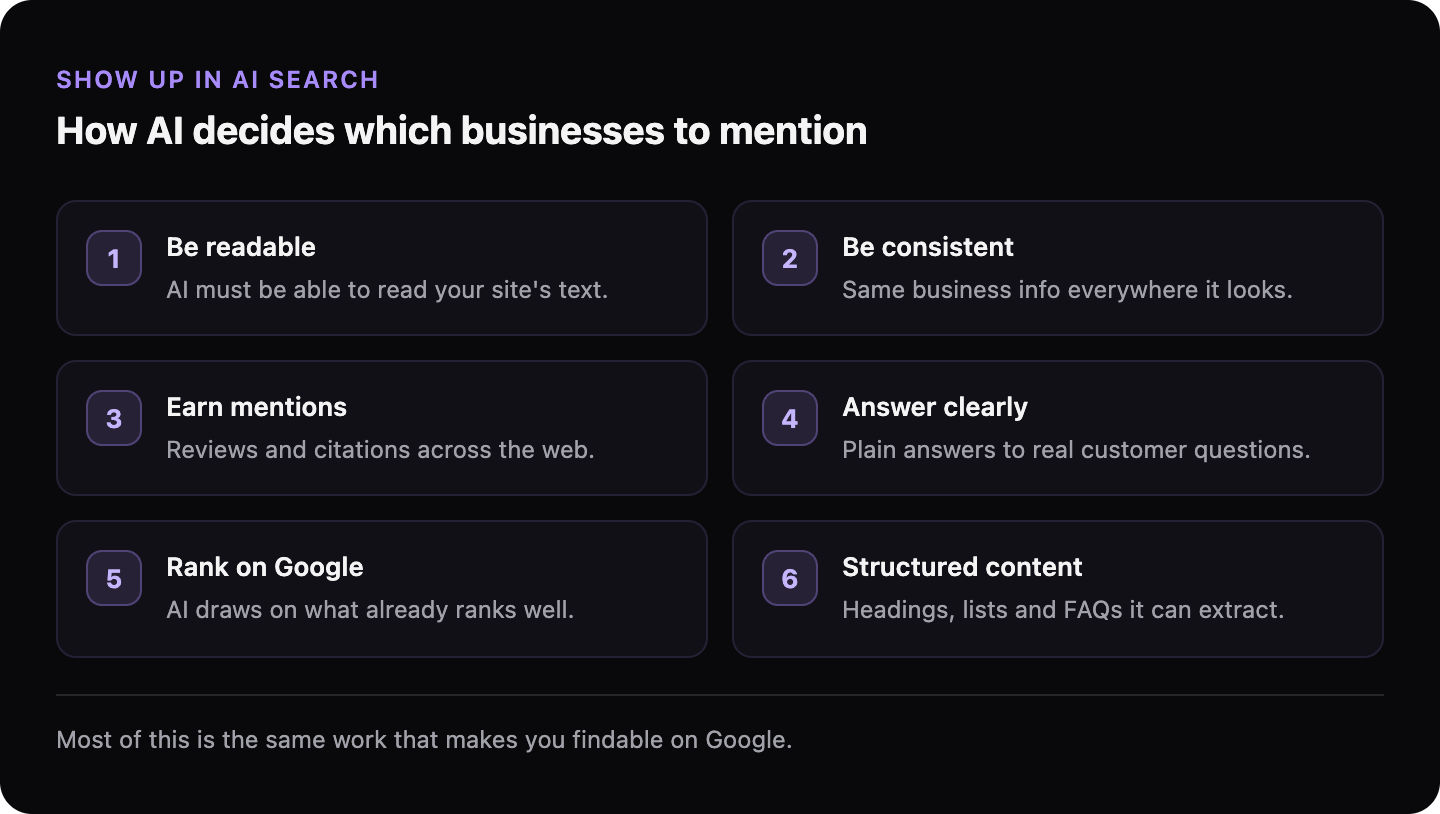
Mostly yes, with additions. The AI still relies on content being crawlable, clearly written, and trusted — the same basics that get you ranked in Google. If Google can’t read your site, neither can the AI summarising it.
The additions: AI favours content that answers a specific question directly and plainly, and it leans on what other sources say about you (reviews, mentions, listings), not just your own site.
→ Read more: Does AI search use the same SEO as Google?
Can the AI even read your website?
This is the foundation. AI answers are built from content the systems can crawl and parse. A site that’s blocked, unreadable, or has no real text gives the AI nothing to work with — so it cites a competitor instead.
If you’ve ever struggled to show up in normal Google results, the same problems block AI search. Fix those first.
→ Read more: Why your website doesn’t show up on Google
How do you become a source the AI trusts?
AI assistants recommend businesses that look established and consistent across the web — much like local search does. The signals overlap:
- Clear, specific content that directly answers the questions customers ask.
- A consistent presence: matching name, address, and details across your site, Google Business Profile, and directories.
- Genuine reviews and third-party mentions — the AI reads what others say about you.
→ Read more: How does ChatGPT decide which businesses to recommend?
→ Read more: How to rank higher in local search results
What is GEO, and is it different from SEO?
You’ll hear the term GEO — generative engine optimization — for the work of getting mentioned in AI answers. In practice it’s not a separate discipline you do instead of SEO; it’s SEO plus a focus on clear, quotable, question-answering content and off-site trust.
→ Read more: What is generative engine optimization (GEO)?
Should I worry that AI will replace Google entirely?
Not yet, and not completely. AI search is growing fast, but Google’s normal results and Maps still drive most discovery for local businesses. The smart move is to be findable in both — the work overlaps heavily, so you’re not choosing one over the other.
→ Read more: Will AI replace Google for finding businesses?
What to do next
Start with the foundation that serves both Google and AI: a website the systems can actually read, clear content that answers real customer questions, and a consistent, well-reviewed presence across the web.
GhostSite checks whether your site is readable and well-structured — the baseline for showing up anywhere, AI or not. Free, in minutes.